How to Choose a WHS Compliant Warehouse?
Choosing a WHS compliant warehouse is not merely a property decision. It is a practical test of risk control, worker protection, and operational discipline. The U.S. Bureau of Labor Statistics reported a 4.8 recordable injury and illness rate per 100 full-time workers in transportation and warehousing in 2023. That figure deserves attention. A busy loading dock can hide serious hazards.
A reliable Whs Warehouse should show documented inspections, trained forklift operators, clear pedestrian routes, suitable racking, emergency exits, and current incident records. Look closely at the floor. Are spills marked immediately? Are damaged pallets isolated? Can a worker move from the dock to storage without crossing vehicle traffic? These details reveal more than polished brochures. OSHA identifies material handling, powered industrial trucks, ergonomics, slips, trips, and falls as recurring warehousing hazards. The Safe Work Australia model Code of Practice also stresses consultation, hazard identification, and risk control.
Safety researcher Erik Hollnagel describes resilience as “the ability to succeed under varying conditions.” That principle matters here. A warehouse may pass an audit today, yet fail during peak season, poor visibility, or staff shortages. No checklist is perfect. Buyers should question assumptions, verify evidence, and speak with warehouse employees. Certifications help, but they do not replace observation.
This guide explains how to assess a WHS compliant warehouse before signing an agreement. It considers systems, site conditions, contractor controls, emergency readiness, and continuous improvement. The strongest choice may not be the newest building. It is the facility that can prove safe performance when conditions become difficult.
Map WHS duties under the Model WHS Act and state warehouse regulations
How to Choose a WHS Compliant Warehouse?
Map WHS duties under the Model WHS Act and state warehouse regulations.
Choosing a WHS-compliant warehouse starts with duty mapping, not a glossy safety certificate. Under the Model WHS Act, the warehouse operator is usually the PCBU, carrying the primary duty of care. Officers must exercise due diligence through active inspections, risk controls, and incident reviews. Workers must take reasonable care and follow reasonable safety instructions. Designers, manufacturers, importers, suppliers, and installers may hold separate duties. These duties can overlap. That overlap matters.
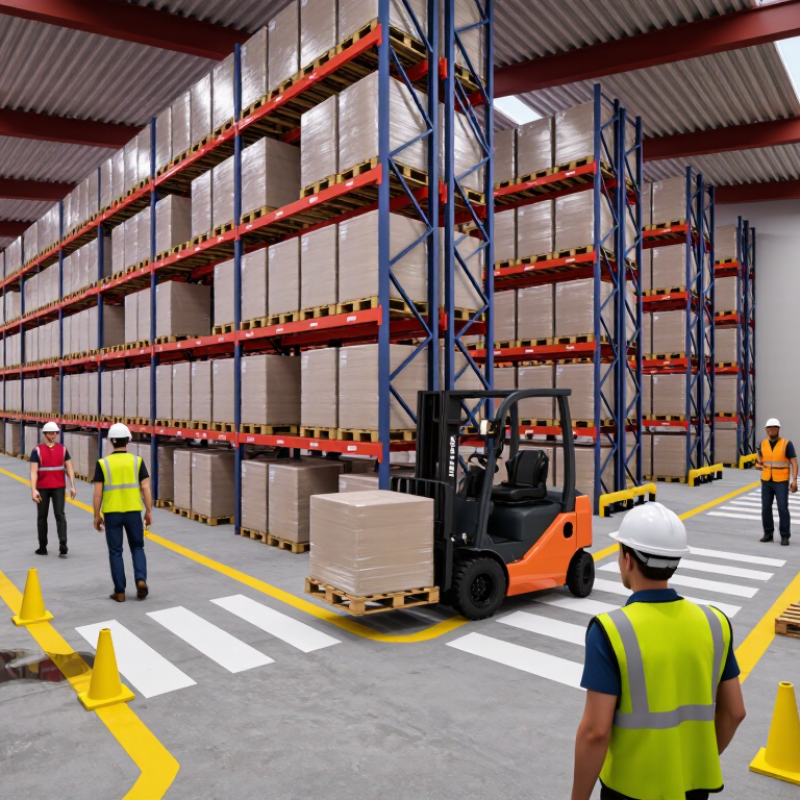
State and territory laws adopt the Model WHS framework differently. Check the local Act, regulations, approved codes, and regulator guidance before signing a lease. Review requirements for forklifts, vehicle-pedestrian separation, hazardous chemicals, manual handling, plant guarding, emergency exits, lighting, and working at heights. A warehouse may appear orderly while its loading dock remains unsafe. Traffic plans need physical barriers, marked walkways, speed controls, and visible sightlines. Paperwork alone is not enough.
Safe Work Australia’s Key Work Health and Safety Statistics Australia 2024 recorded 200 worker fatalities from traumatic injuries in 2023. The Australian Bureau of Statistics estimated 1.3 million people experienced work-related injury or illness in 2021–22. These figures show why compliance checks need evidence. Request maintenance records, training logs, emergency drills, risk assessments, and corrective-action registers. Test controls during a busy shift, not only during a quiet inspection. Some gaps will be missed. Document them honestly, assign owners, and verify completion against the applicable state requirements.
A WHS-compliant warehouse should be assessed against both the general duties in the Model WHS Act and the more specific controls in the Model WHS Regulations. State and territory legislation may adopt, modify or supplement these provisions, so the relevant local regulator’s requirements must be verified before selection.
Compare risk with Safe Work Australia’s 2023 rate: 1.5 fatalities/100,000
Choosing a WHS-compliant warehouse begins with measurable risk, not polished photos. Safe Work Australia recorded 1.5 work-related fatalities per 100,000 workers in 2023. That figure gives managers a national benchmark, but it does not reveal every warehouse hazard. Examine traffic routes, loading docks, racking stability, emergency exits, and forklift separation during a physical inspection.
Request current incident records, near-miss reports, inspection logs, and corrective-action evidence. The Australian Bureau of Statistics reported 497,300 people experienced work-related injuries in 2021–22. This reinforces a practical point: minor events can expose serious system weaknesses. Look for damaged pallets, blocked fire equipment, poor lighting, and pedestrians crossing vehicle paths. Ask who controls each risk, and when it was last reviewed.
Walk the site during a busy shift. Quiet conditions can hide dangerous congestion. Check whether workers can explain evacuation procedures, manual-handling controls, and reporting channels without prompting. Verify training records, maintenance schedules, contractor inductions, and risk assessments against actual practice. A document alone is weak evidence. So is a spotless floor. I would also challenge my own inspection: did I observe normal operations, or only a prepared demonstration? Independent WHS advice may be worthwhile when the warehouse handles heavy goods, elevated storage, or frequent vehicle movements.
Inspect racking and storage against AS 4084.1:2023 load and damage controls
How to Choose a WHS Compliant Warehouse?
A WHS-compliant warehouse needs more than clean aisles and warning signs. Safe Work Australia reported 200 worker fatalities in 2023, highlighting the cost of uncontrolled workplace hazards. The UK Health and Safety Executive recorded 604,000 non-fatal workplace injuries in 2023/24. Racking damage deserves serious attention.
Inspect every upright, beam, connector, brace, and floor anchor against AS 4084.1:2023. Check that stored loads match the rack’s rated capacity. Load plaques should remain visible and readable. Bent steel is not a cosmetic issue. A small impact can reduce structural capacity, especially near a column base.
Walk the aisles during normal operations. Look for forklift marks, leaning frames, missing locking pins, overloaded beams, and pallets extending beyond support areas. Photograph defects and record their location. Isolate seriously damaged bays immediately. Do not “monitor” severe deformation for weeks.
A competent person should assess damage and approve repairs. Replacing one component without checking the full bay can create a hidden weakness. Warehouse teams also need practical training, not paperwork alone. Short briefings near the racks often work better. Still, training fades. Reinspect after layout changes, impacts, or unusual loading.
AS 4084.1:2023 should guide the inspection process, but site conditions require judgement. Check the standard, engineering advice, and applicable WHS duties together. A perfect checklist can still miss a rushed forklift movement. That is where honest review matters.
Verify forklift competence, traffic separation, and plant risk controls
Choosing a WHS-compliant warehouse starts with people, movement, and plant controls.
Forklift operators need verified training, current authorisation, and task-specific competence. A licence alone may not prove safe performance in narrow aisles, loading docks, or uneven yards. The US Occupational Safety and Health Administration estimates forklifts cause about 85 fatal incidents and 34,900 serious injuries annually. That figure deserves attention, even in Australian warehouses.
Traffic separation must be visible and physical where possible.
Use barriers, marked pedestrian crossings, speed controls, mirrors, and one-way routes. Keep pedestrians away from reversing zones and blind corners. Safe Work Australia’s Work-related Traumatic Injury Fatalities data shows that vehicle-related incidents remain a serious workplace risk. A painted line can look compliant yet fail when pallets block it. Plant risk assessments should cover guarding, maintenance, battery charging, attachments, visibility, and emergency isolation. Review controls after layout changes, near misses, or new equipment.
Tips:
Watch one complete shift. Record where people hesitate, step around barriers, or communicate by hand signals. Ask operators what feels unsafe. Their answers may expose weaknesses that paperwork misses. Check maintenance records, pre-start inspections, training evidence, and incident trends. Do not rely on assumptions. A quiet warehouse can still contain uncontrolled energy, poor visibility, or rushed decisions. Then test whether each control works during peak receiving periods, not only during a scheduled inspection.

 +8618862309186
 CONTACT NUMBER
 CONTACT NUMBER
 CONTACT NUMBER