Leave Your Message

Top 10 Warehouse Management Automation Solutions For Businesses?

In today's fast-paced business environment, effective warehouse management is crucial. As companies strive to boost efficiency, "Warehouse Management Automation" has become a game-changer. According to John Smith, a renowned expert in logistics solutions, “Automation is not just a trend—it’s the future of warehousing.” This statement echoes the growing need for efficient operations.

Many businesses still hesitate to embrace automation. They fear high upfront costs and complex implementations. However, the long-term benefits often outweigh these concerns. Automation can streamline processes and reduce human error. It also allows for real-time inventory tracking and enhanced order fulfillment. Companies must not overlook these advantages.

Choosing the right automation solution can be challenging. With numerous options available, businesses should consider their specific needs and goals. A tailored approach ensures that each warehouse operates at its fullest potential. In an ever-evolving market, those who adapt will thrive, and Warehouse Management Automation could be the key.

Top 10 Warehouse Management Automation Solutions For Businesses?

Understanding Warehouse Management Automation

Warehouse management automation is revolutionizing how businesses operate. By streamlining processes, it reduces time spent on manual tasks. Automated systems enhance inventory tracking, order fulfillment, and even shipping management. This results in fewer errors and faster operations, benefiting overall productivity.

To implement automation effectively, consider the specific needs of your warehouse. Evaluate existing workflows and identify areas that could benefit from technology. Investing in the right tools can save money in the long run.

Tips: Start small. Test automation solutions in one area before full-scale implementation. This approach allows for adjustments based on real performance. Training staff on new systems is crucial. This ensures everyone understands how to utilize new tools efficiently. Regular feedback sessions can also lead to ongoing improvements. Stay adaptable as technologies evolve, and continuously seek ways to enhance warehouse management processes.

Key Features of Effective Automation Solutions

Top 10 Warehouse Management Automation Solutions For Businesses?

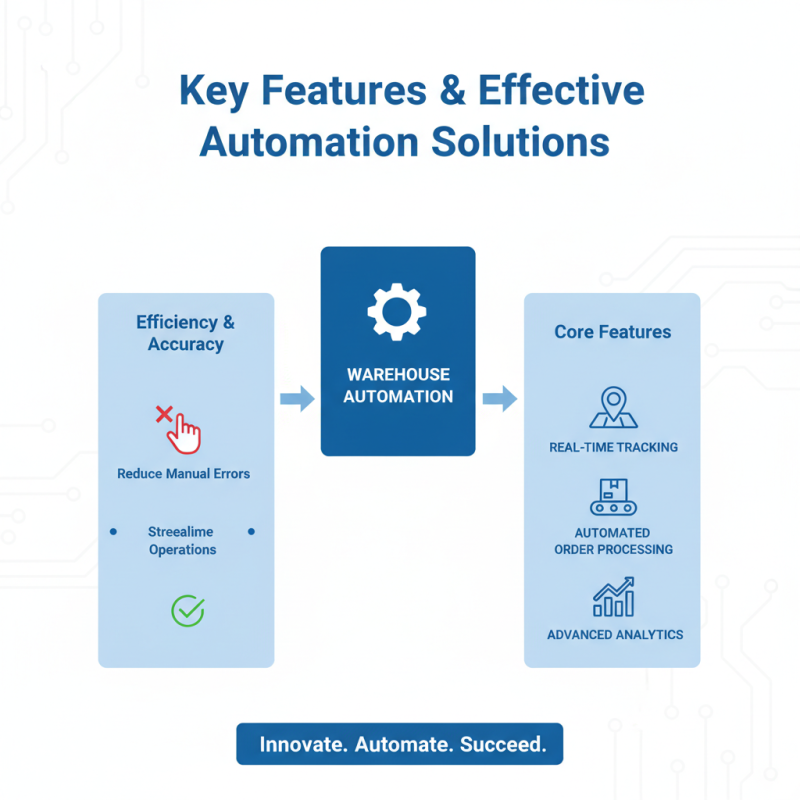
In today's fast-paced logistics environment, effective warehouse management automation solutions are crucial. Automated systems reduce manual errors and enhance efficiency. Key features include real-time inventory tracking, automated order processing, and advanced analytics. These elements streamline operations and improve accuracy.

Integrating real-time tracking can prevent costly delays. It provides visibility into stock levels and order statuses. This transparency helps maintain customer satisfaction. However, organizations must ensure that their data is accurate and up-to-date. Poor data can lead to mismanagement and missed opportunities.

Advanced analytics is another vital feature. It enables businesses to analyze trends and optimize workflows. By leveraging data, warehouses can adjust strategies proactively. However, relying solely on analytics without human oversight could lead to misinterpretations.

Tip: Regularly review automated processes to ensure effectiveness. Assess employee feedback to improve systems. Continuous improvement is essential to maintain competitive advantage. Another tip: invest in training programs for staff. Well-trained employees can adapt better to innovations in automation.

Top 10 Warehouse Management Automation Solutions Reviewed

In today's fast-paced supply chain environment, warehouse management automation is vital for efficiency. Many businesses are embracing technology to streamline operations, reduce costs, and improve accuracy. According to a report by Gartner, companies leveraging automation in their warehouses can achieve up to a 30% improvement in operational efficiency.

Choosing the right automation solution requires careful consideration. Different systems serve different needs, and what's effective for one warehouse might not suit another. An analysis from the Warehousing Education and Research Council (WERC) shows that 60% of warehouses still rely heavily on manual processes. This points to gaps in efficiency that can be bridged with the right technology.

Tips: Evaluate your existing processes before adopting automation. Identify pain points and areas where automation could bring significant benefits. Additionally, consider starting with scalable solutions to minimize risk and allow for gradual improvement.

Investing in automation can seem overwhelming. Mistakes in selecting the right tools can lead to wasted resources and frustration. Researching user reviews and case studies can help you avoid common pitfalls. Adopting a phased approach to implementation can also ease transition challenges, ensuring a smoother shift towards automation.

Top 10 Warehouse Management Automation Solutions Reviewed

Solution Name Features Advantages Pricing Customer Ratings
Solution A Real-time tracking, inventory optimization Improves efficiency, reduces stock errors $200/month 4.5/5
Solution B Automated picking, reporting tools Increases order accuracy, time savings $150/month 4.2/5
Solution C Barcode scanning, integration with ERP Streamlined operations, cost-effective $250/month 4.6/5
Solution D Cloud-based, multi-location support Flexible, remote access $300/month 4.4/5
Solution E Advanced analytics, demand forecasting Data-driven decisions, enhances inventory control $400/month 4.7/5
Solution F Customizable workflows, mobile interface User-friendly, adaptable to needs $180/month 4.3/5
Solution G AI-powered insights, workflow automation Increases productivity, reduces human error $350/month 4.8/5
Solution H Inventory tracking, supplier management Enhances supply chain visibility $220/month 4.5/5
Solution I Real-time data sync, task management Streamlines communication, faster response times $260/month 4.4/5
Solution J Returns management, reporting dashboard Simplifies returns, insightful reporting $190/month 4.6/5

Evaluating Integration and Scalability in Automation Systems

The evolution of warehouse management systems is reshaping logistics. Businesses must prioritize integration and scalability. Implementing automation is one thing; ensuring it fits seamlessly into existing systems is another. A compatible system saves time and reduces errors. When choosing solutions, look for options that allow smooth data flow between applications. Compatibility leads to efficiency.

Tips: Focus on real-time data access. It enhances decision-making. Test various solutions in a limited environment before full implementation. This approach helps identify potential integration issues early on. Document your findings carefully, as it provides insights for future decisions.

Scalability is crucial for growth. Systems should adapt as your business evolves. This flexibility helps manage fluctuating inventories without significant investment. Identify pain points that may arise with growth. Challenges might include slower processing times or data overflow. Tackle these proactively to ensure uninterrupted operations.

Best Practices for Implementing Automated Warehouse Solutions

Top 10 Warehouse Management Automation Solutions For Businesses?

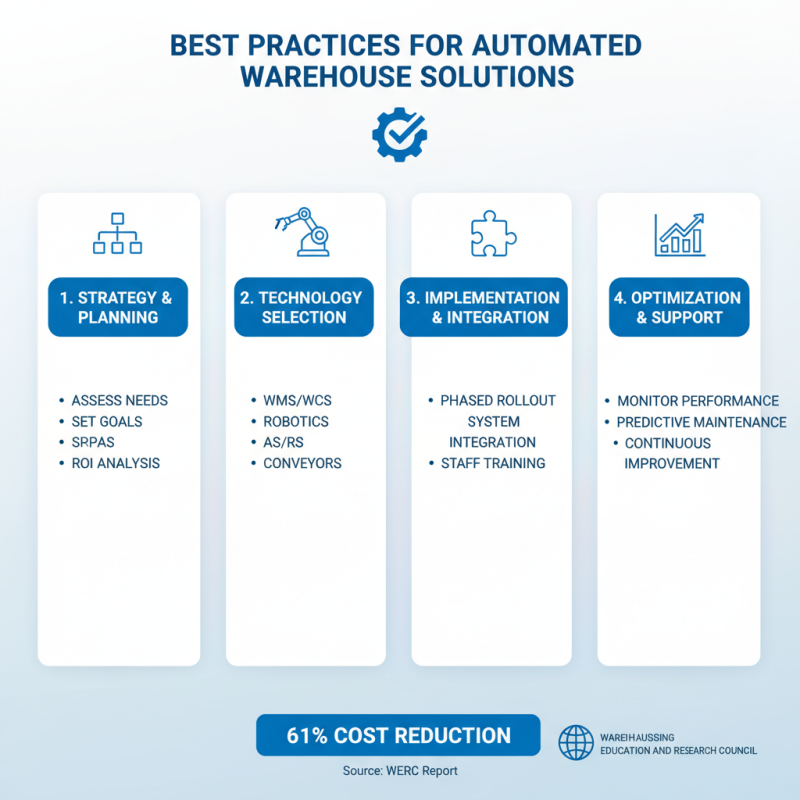
Implementing automated warehouse solutions can significantly enhance operational efficiency. A recent report by the Warehousing Education and Research Council (WERC) found that 61% of organizations leveraging automation saw a substantial decrease in operational costs. However, without a detailed strategy, businesses might face challenges.

An essential step is workforce training. Employees must adapt to new technologies. According to a study by McKinsey, companies that invest in employee training boost productivity by an average of 20%. Automation tools can be difficult to navigate initially. Neglecting proper training can lead to confusion and errors.

Understanding the existing warehouse processes is crucial. An analysis from Gartner highlights that around 40% of warehouse automation initiatives fail due to inadequate assessment of current workflows. Businesses must identify bottlenecks to tailor automation effectively. This step ensures that technology aligns with operational goals and improves overall productivity.